Most EV cost calculators make you hunt for your electricity rate. What's The Charge auto-detects your state and rate plan on load, pre-fills your charger specs, and delivers a real cost estimate in under 10 seconds — no account required.
New EV owners know gas costs money per gallon. Electricity costs money per kWh — but rates vary wildly by state, utility, and time-of-use plan. Most people have no idea what they're actually paying to charge at home, whether a Level 2 charger is worth buying, or how DC fast charging compares. Existing tools either buried users in inputs or oversimplified to the point of being useless.
The entire design philosophy is: get out of the user's way. Auto-detect their location, pre-set the most common charger level, pull their state's standard utility rate — then let them override anything. Most users never touch the defaults.
Geolocation
State auto-set on load
Rate lookup
Default utility rate pulled
Vehicle select
Year / Make / Model / Trim
Charger config
Level 1 / 2 / DC Fast
Instant result
Cost + time estimate
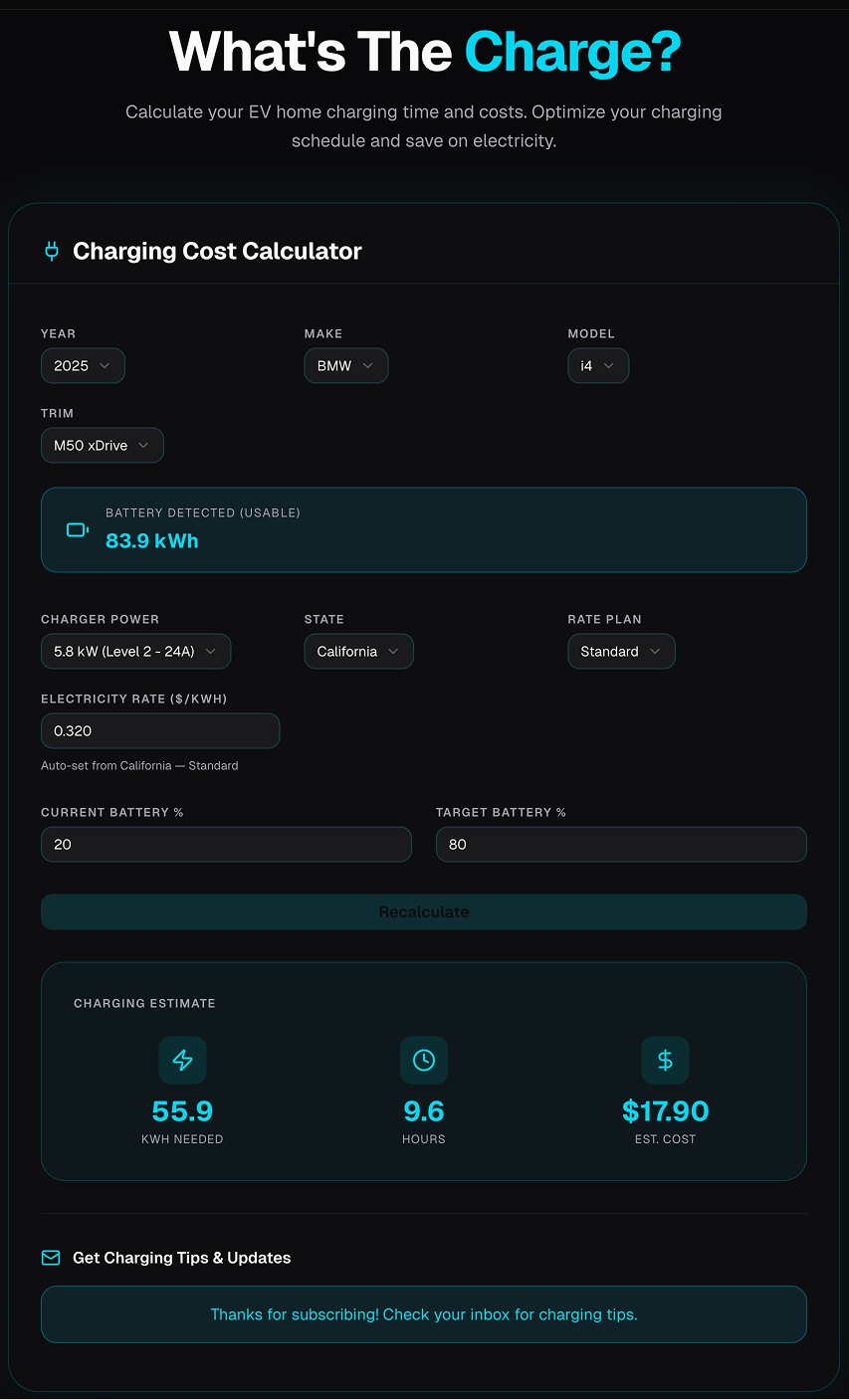
The calculator has exactly the inputs it needs and none it doesn't. Each decision was made by asking: would a typical EV owner know this off the top of their head?
Browser geolocation sets your state on load. The most common utility rate plan is pre-selected, with an override dropdown for TOU and EV-specific plans.
Year → Make → Model → Trim. Each selection filters the next. Battery size and efficiency data are populated automatically — no manual spec lookup required.
Level 1 (standard outlet), Level 2 (home charger), and DC Fast Charging — each with real-world kW defaults. Advanced users can dial in exact charger output.
EV culture skews tech-forward. A dark theme with a cyan accent color felt native to that audience — and performs well for nighttime use when most people plug in.
The result screen shows charging time, total cost, cost per mile equivalent, and a comparison against local gas prices — giving the user immediate context for whether their EV is saving them money.
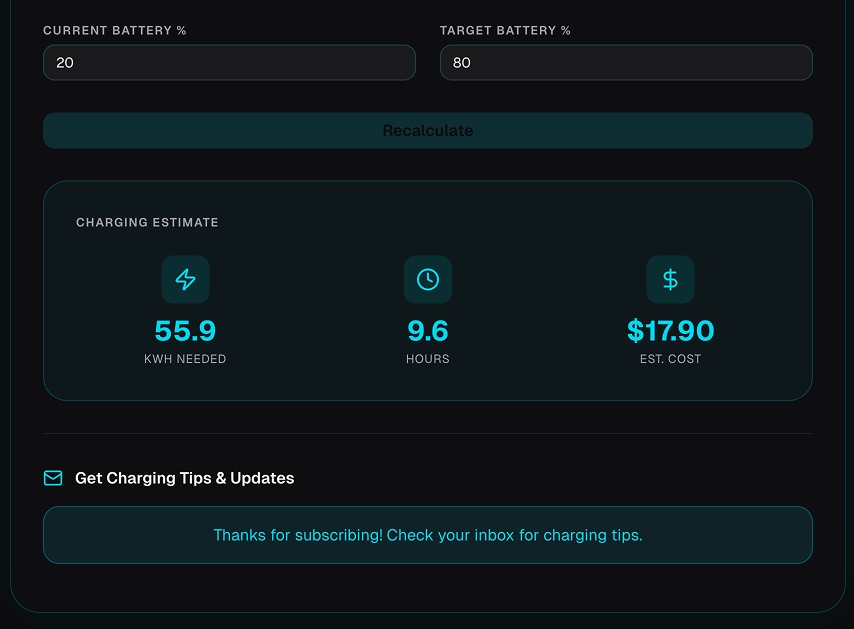
Based on your vehicle's battery size, current charge level, target charge level, and charger output — not a generic range pulled from a spec sheet.
Total cost for this session, cost per full charge, and monthly cost at typical driving patterns — all calculated from your actual utility rate, not a national average.
The equivalent MPG cost at local gas prices puts the savings in a frame of reference every driver already understands.
Calculator state is encoded in the URL — users can bookmark their setup or share a direct link with their exact vehicle and rate configuration.
What's The Charge is a fully custom web application built with Next.js and deployed on Vercel. The vehicle database covers hundreds of makes and models with real battery capacity and efficiency data. Utility rate data is sourced from public EIA datasets and kept current by state. No third-party calculator API — every formula is written and owned in-house, which means full control over accuracy and UX.
 Jason Bedient